Wednesday, November 16, 2011

What CNN didn't see at Zuccotti Park: Mark di Suvero's "Joie de Vivre"

I watched a segment on CNN yesterday about the eviction of the Occupy Wall Street protesters from Zuccotti Park. The video footage was shot from a helicopter overhead, which showed the empty park surrounded by barricades with protestors gathered around the perimeter. The economist Jeffrey Sachs was commenting on voiceover about the OWS movement marking change in America. No one mentioned the park’s 70-foot-tall sculpture, Joie de Vivre, by Mark di Suvero that was repeatedly shown in the footage. The CNN video was shot before the protesters were allowed to return to the park.

There is a fascinating story to be told which the major news organizations have egregiously overlooked. This monumental red steel work was created by an artist who lives in New York City and opposed the wars in Vietnam and Iraq. Think of di Suvero’s sculptures which directly addressed the two wars, Peace Tower and Mother Peace. Joie de Vivre was installed at the corner of Broadway and Cedar Street in 1996. di Suvero is married to Kate Levin, who is Mayor Bloomberg’s Commissioner of the Department of Cultural Affairs. On November 7, 2011, the OWS Arts and Culture Group sent a letter to di Suvero asking him to urge the city to remove barricades around the work that had been set up after one of the protesters climbed on the sculpture.

I was struck by the fact that there has been a paucity of discourse on the metaphorical role of a sculpture that was made by an antiwar protester and inadvertently situated in the middle of the OWS camp. The protesters and media will eventually move on but Joie de Vivre will remain in Zuccotti Park as a silent, powerful and resilient presence.

Watch the November 15, 2011 video clip on http://www.cnn.com/:
“Sachs: OWS movement marks change”

Thursday, October 27, 2011

Hudson River Valley Getaway


Lover's Leap overlooking the Hudson River at Buttermilk Falls Inn & Spa
While I was enjoying the fall foliage this past weekend in the Hudson River Valley, I found a gem of a spot called the Buttermilk Falls Inn & Spa in Milton, NY. I had heard about the inn’s restaurant, Henry’s Farm to Table, but had not visited the property.

Henry's Restaurant
I took the morning train from Grand Central to Poughkeepsie and then a 15-minute cab ride across the Mid-Hudson Bridge to Milton. I had called Henry’s in advance for a lunch reservation and I was seated at a window table overlooking Swan Pond. The chef utilizes organic produce from Millstone Farm, which is located onsite. I ordered the fresh grilled vegetable wrap greens with Fontina cheese. The service was very slow because Henry’s was short on staff. I heard my server apologize to guests at a nearby table that only two chefs were in the kitchen. But the dining room did not have enough wait staff, either. It took an inordinate amount of time for my glass of wine to be served. My veggie wrap tasted fresh and light. For dessert, I ordered the apple crisp, but I was later informed that it was not available and so I selected the poached pear with a scoop of ginger and cinnamon ice cream. The pear was uninspiring but the ice cream was worth the calories.

Buttermilk Falls Inn
After lunch, I walked over to the inn to pick up a map of the property. The inn was built in 1764 and includes 10 guest rooms. Additional accommodations include four guesthouses and a former barn. A private party had booked the entire property for that evening which precluded me from viewing any of the rooms.

View from the inn's patio overlooking South Pond and the Hudson River
I began my stroll of the 75-acre estate from the inn’s patio, which had an exquisite view towards the Hudson River. It looked like an autumnal painting. I followed the path towards the river to Lover’s Leap, where I observed a couple of lovers enjoying the serene view from their Adirondack chairs. I then stopped by the tennis court before heading to Swan Pond.

A new friend
Organic Garden and Barn
I crossed the bridge over the pond to Millstone Farm, which encompasses the organic garden, barn, beehives, llamas, Angora goats, alpacas, peacocks and chickens.

The Spa
I then walked over to the Spa, which was taking advantage of the fall harvest of herbs by incorporating them into handmade oils in signature treatments. I was given a brief tour of the pool, which had a delightful view overlooking the garden.

The beauty and serenity of the property, the indulgent spa treatments and charming variety of accommodations entice me to return as an overnight guest. But the restaurant needs to raise the level of service if they want to have repeat business. 

http://www.buttermilkfallsinn.com/
845-795-1310

Thursday, October 20, 2011

Jean Nouvel & Jane's Carousel in Brooklyn, NY


Jane's Carousel in Jean Nouvel's Pavilion
In December, 1999, I visited the Cartier Foundation for Contemporary Art in Paris with my Dad. I distinctly remember the striking transparency and lightness of the Jean Nouvel-designed building. His “glazed barrier” of glass dissolved the delineation of the interior and exterior spaces. 

I read an article in The New York Times in September, 2011 about the opening of Jane’s Carousel in Brooklyn Bridge Park and Nouvel, a Pritzker Prize winner, had been commissioned to design a $9 million transparent pavilion to house the carousel. It was originally made in 1922 by the Philadelphia Toboggan Company and installed in a theme park in Youngstown, Ohio.

Looking into the pavilion
The carousel was purchased at an auction in 1984 by David and Jane Walentas for $385,000. David was the original developer of the Dumbo area of Brooklyn and Jane, who is an artist, began the restoration of the carousel soon after they bought it. The original idea was to include the carousel in a marina and shopping complex along the waterfront between the Brooklyn and Manhattan bridges. The plan was later abandoned and a park was created instead. Once the Walentases received political support for the park, they hired Nouvel. The carousel is their gift to the city. 
My initial view of Nouvel's pavilion in the park
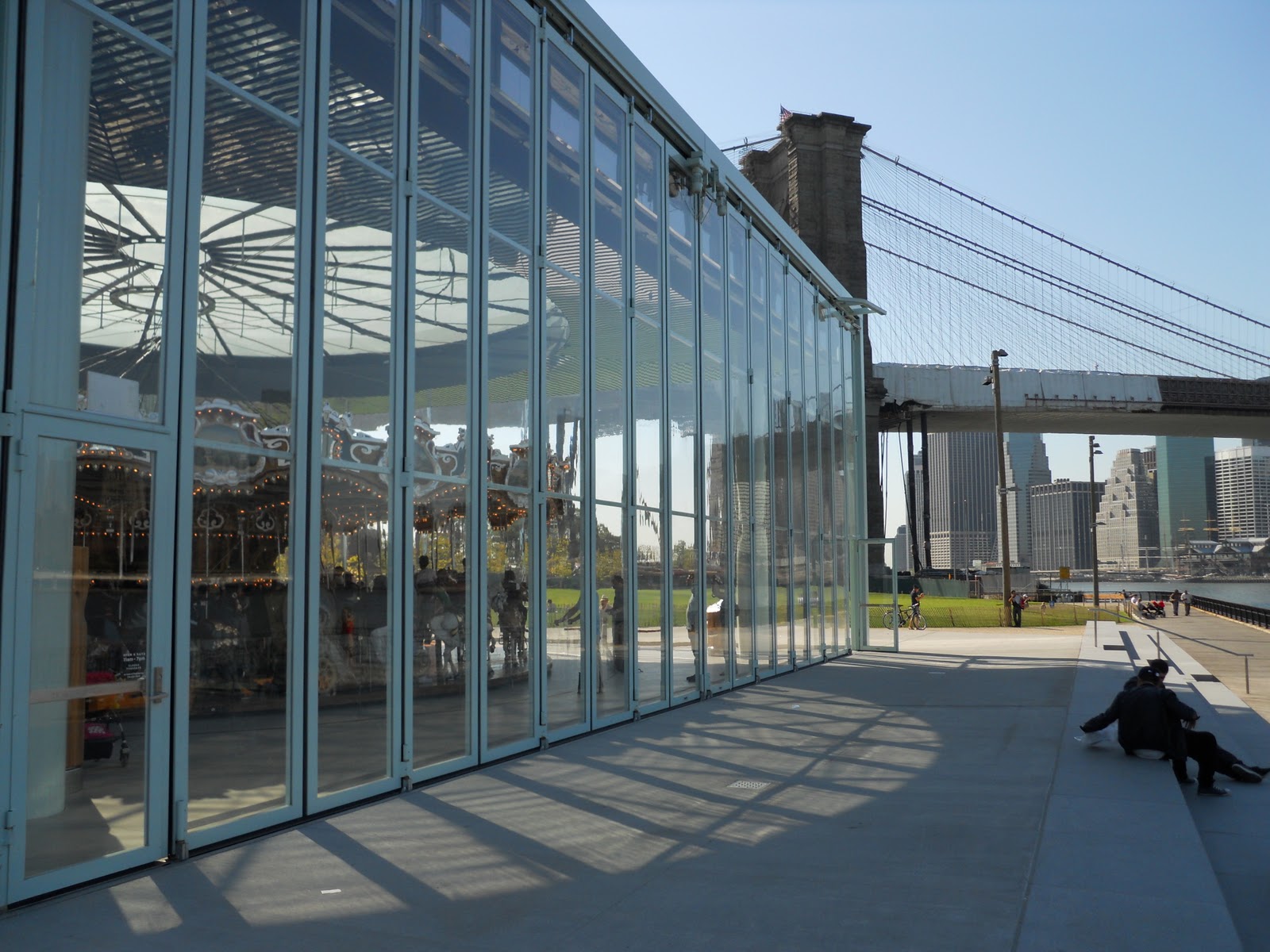
My first impression of the structure was its dramatic location along the East River. From a distance, it looked like the carousel was in a glass-enclosed box. However, as I got closer to the pavilion, I could tell that the walls were made of acrylic instead of glass. Nouvel wanted to create a slight distortion as you look in and out. The acrylic panels cost over $1 million.
Looking out of the pavilion at Brooklyn Bridge
The Walentases originally asked Nouvel to design a round building, but the architect said that it would not look appropriate on that site and he wanted a square shape instead with each wall 72 feet long and a ceiling height of 26 feet. Nouvel considers the carousel to be a bijou in the middle of the box. This jewel is in stark contrast to the surrounding warehouses and bridges. 
On the carousel
The carousel itself is quite beautiful. It is a 3-row machine with 48 carved horses and two chariots. The scenery panels, crests, center pole and platform are original. Each ride is only $2 and I couldn’t resist going three times. The adults seemed to enjoy it as much as the children. Being in motion on the carousel while looking out through the acrylic walls at the bridges and buildings was a bit surreal but great fun. Because the weather was warm, the side of the pavilion facing the park was completely open and thus there was no barrier between indoor and outdoor space. At night, images of horses are projected against white shades within the pavilion to give the effect of a magic lantern.

http://www.janescarousel.com/

Sunday, October 2, 2011

Must-see New York Contemporary Art Shows: Fall 2011

Please note that the following exhibitions are listed by closing dates.
Andreas Gursky
Gagosian Gallery
522 W. 21st St.
http://www.gagosian.com/
on view through December 17, 2011

Barnett Newman: Paintings
Craig F. Starr Gallery
5 E. 73rd St.
http://www.starr-art.com/
on view through December 17, 2011

Calder:1941
The Pace Gallery
32 E. 57th St.
on view through December 23, 2011

Howard Hodgkin
Gagosian Gallery
980 Madison Ave.
http://www.gagosian.com/
on view through December 23, 2011

Joan Mitchell: The Last Paintings
Cheim & Read
547 W. 25th St.
http://www.cheimread.com/
on view through January 4, 2012

de Kooning: A Retrospective
The Museum of Modern Art
11 W. 53rd St.
on view through January 9, 2012

Carsten Holler: Experience
New Museum
235 Bowery
http://www.newmuseum.org/
on view through January 15, 2012

Maurizio Cattelan: All
Solomon R. Guggenheim Museum
1071 Fifth Ave. (at 89th St.)
http://www.guggenheim.org/
on view through January 22, 2012

Ray Parker: Simple Paintings from the 1960s
Washburn Gallery
20 W. 57th St.
http://www.washburngallery.com/
on view through January 28, 2012

Thursday, September 29, 2011

What is "Contemporary" in Boston? Sportello & ICA

Begin your afternoon in Boston with lunch at Sportello, which is chef Barbara Lynch’s concept of “a modern interpretation of the classic diner.” She is a James Beard-award winner and native Bostonian who adroitly executes a cool minimalism in her menu and restaurant design. Sportello opened in Fall 2008 in the Fort Point neighborhood. On a recent Sunday, I ordered the shrimp and avocado salad with endive, grapefruit and tarragon ($12) with a glass of freshly squeezed OJ. My friend enjoyed the cheddar cheese panini with tomato confit and bacon ($13). Don’t miss the irresistible goodies at the bakery counter!
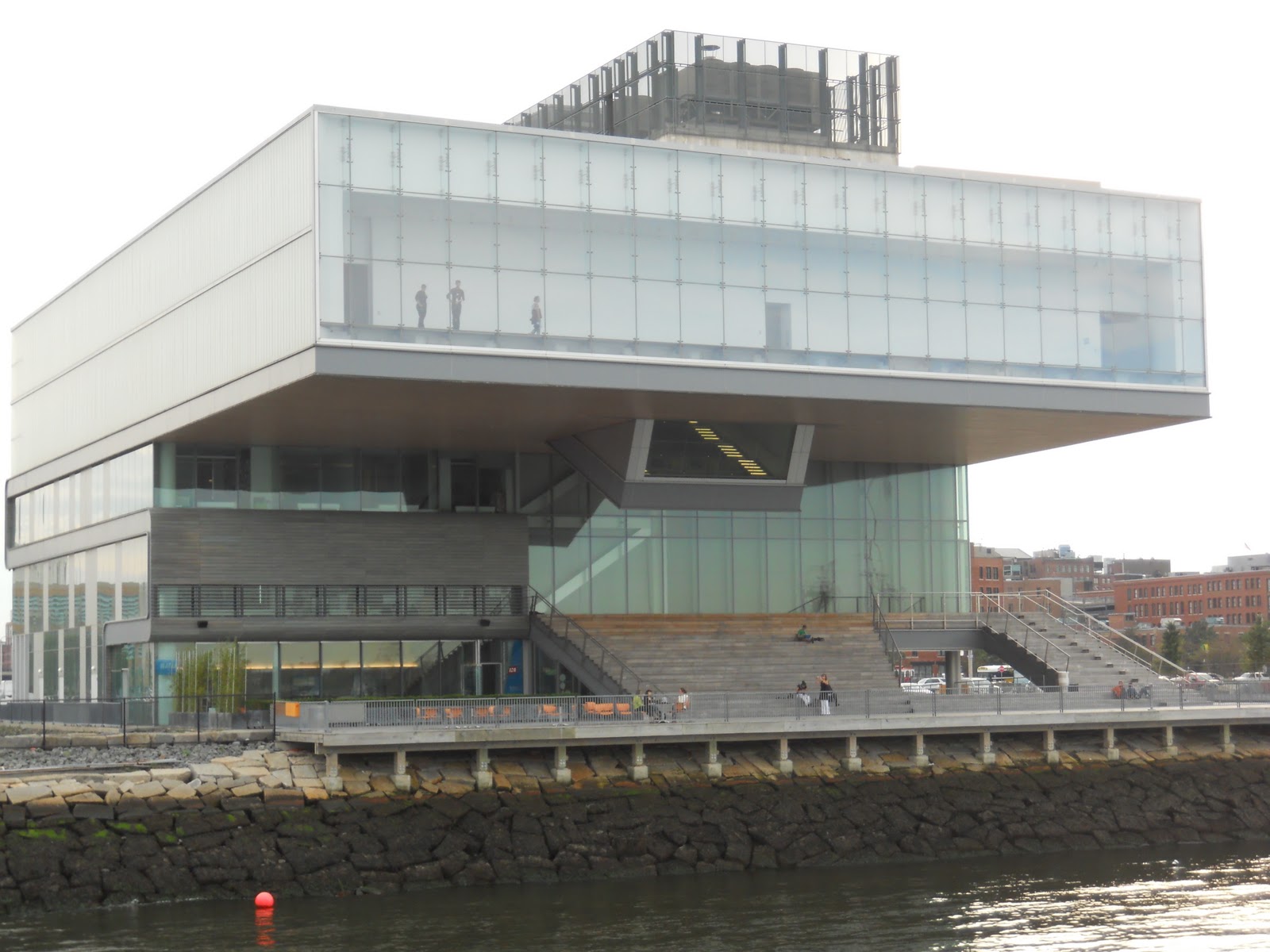
View of ICA from harbor
Walk off your lunch with a 10-minute stroll to the Institute of Contemporary Art/Boston, which is located in the revitalized waterfront area. The five-year-old museum was designed by Diller Scofidio & Renfro, the team that also designed the High Line in NYC.

Grandstand under cantilever
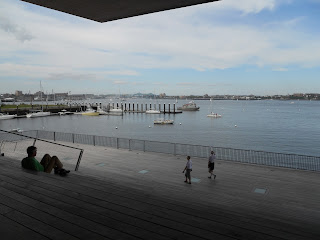
View of harbor from grandstand
The exterior of the building is best viewed from the side that faces the harbor with the dramatic cantilever that extends over the grandstand with public seating. You will most likely approach the museum from the parking lot/street and this view of the building is truly unremarkable. When I visited recently, I walked around the perimeter of the building before going inside, and considering the building from a 360-degree perspective, it was architecturally disappointing. I thought of Frank Gehry’s Guggenheim Bilbao museum and how the building reveals something new from every exterior angle. The ICA does not remotely compare to Bilbao in this respect.

Please note that since interior photography of the museum is not permitted, I can only include photos from the exterior of the building.

The Water Café on the ground floor has a sleek, modern design. But the bookstore behind the admission desk gives the impression of a design afterthought.

Once you have your admission ticket, take the 140-square-foot elevator to the fourth floor, which is the only floor with galleries. The theater occupies the second and third floors. On my recent visit, a portion of the fourth floor was closed because of an installation, which further reduced the art viewing options, and a memorial service was scheduled that afternoon in the theater. I was informed that I could bring my ticket back in October for free admission once the new show opened. 

The two distinctive architectural spaces on the fourth floor are the Mediatheque and the Founders' Gallery.

The Mediatheque under the cantilever
The Mediatheque is suspended from under the cantilever and provides a vertiginous view of the water. The architects used the concept of a viewfinder in framing this perspective of the water. There are a number of computer stations for accessing information about the museum, artists and exhibitions. But it is the combination of the dramatic view and the extreme verticality of the space that makes the Mediatheque a sensational experience.

The Founders' Gallery
The north end of the fourth floor features the Founders' Gallery, which spans the width of the building, and the floor-to-ceiling windows face the harbor. The Gallery is essentially a corridor which connects two galleries but does not display any art. Be sure to walk the length of the Gallery and take a few minutes to sit and enjoy the view.

Eva Hesse: Studiowork is a gem of an exhibition. Hesse was an important American sculptor who died in 1970 at the age of 34. The show features experimental and rarely exhibited works which bring to light the range of unusual materials and techniques that she used. The show is on view through October 10, 2011.


Sportello
348 Congress St.
Boston, MA 02210
Tel: 1.617.737.1234
http://www.sportelloboston.com/

The Institute of Contemporary Art/Boston
100 Northern Ave.
Boston, MA 02210
Tel: 1.617.478.3100

Monday, August 22, 2011

High Line Art: Sarah Sze

The High Line
A must-see installation this summer is Sarah Sze’s sculpture, Still Life with Landscape (Model for a Habitat), on the High Line’s newly opened Section 2, which extends from West 20th to West 30th Streets in Manhattan. Sze’s piece is between West 20th and West 21st Streets. Constructed in stainless steel, wood, paint and concrete, the work features birdhouses suspended along its metallic web. The viewer interacts with the sculpture by walking between the two pieces which line each side of the elevated walkway. This avian housing project provides food, shelter and water for birds, butterflies and insects and is a clever architectural experiment in synthesizing our habitat with nature.
North-facing view
When you face north on the High Line, take note of how the piece on your  right (east side of the path) interacts with the vertical landscape behind it. Sze’s work draws your eye up to the roof life of the brick building that serves as a backdrop. The birdhouses echo the shapes of the building’s turrets.
South-facing view
The other half of the piece that is best viewed when you face south (west side of the walkway) lacks the dynamic engagement that you see on the other side, but nevertheless provides the essential complement to it.

Detail of sculpture
Be sure to look closely for signs of wildlife as I saw several birds on the sculpture and observe how the human visitors engage with this fascinating work. One viewer commented that the birdhouses were the new rental apartments for this volatile economy.


Still Life with Landscape (Model for a Habitat)
on view through June, 2012

Tuesday, August 16, 2011

Kayaking on Long Island, NY


Peconic River
Kayaking in Oyster Bay last weekend was the catalyst for me to investigate other kayaking options on Long Island. I had not explored the Peconic River, which is the largest river on Long Island. It flows eastward through forests and farms and eventually empties into Peconic Bay, which encompasses the two bays between the North Fork and South Fork of Long Island. The town of Riverhead seemed to be the place to launch the kayak and so I looked for an outfitter in that area. I found Peconic Paddler, which rents kayaks, canoes and stand-up paddleboards.
On Saturday morning, I jumped on the train at Penn Station and headed out east. A little over two hours later, I was in Riverhead and it was a short walk from the train station to Peconic Paddler.
Peconic Paddler
I was assigned a yellow, sit-in kayak that had been stored outdoors the previous night and was full of bugs crawling all over the seat. The staff quickly washed them off and pulled the kayak on a dolly across the street to the launch site. After I secured my backpack in the kayak’s storage compartment, I found more bugs and flipped the kayak over to shake the last of the critters out of there. I then climbed into the cockpit and began the paddle up the river. I had been given a map of the river by the outfitter and was advised that for a two-hour trip, I should explore the bird sanctuary or paddle up to the beach that was past the Indian Island Golf Course.
Within minutes of paddling, I fell into a state of temporary quietude that I desperately needed after having survived a nightmare week of stock market volatility. 
As I paddled eastward, the river broadened and I passed a small marina and a few modest homes. The shoreline was mostly covered in phragmites, a large, perennial grass found in wetlands. I paddled by swans, geese, ducks and a dead crab.
I saw a couple of fellow kayakers turn into the bird sanctuary, but I kept going up the river towards the bay. I paddled under the Route 105 bridge and maneuvered around Osprey Island. The serenity of being on the river was interrupted only by an occasional airplane or jetski. As the beach on the north shore came into view, I decided that it was a good point to turn around and head back to town for lunch.

Jerry & the Mermaid
Jim Dreeben, the owner of Peconic Paddler, recommended Jerry & the Mermaid, a seafood restaurant that was within walking distance in the Treasure Cove Marina. I sat on the patio and ordered a strawberry daiquiri and the seafood stuffed crepe with a Newburg sauce. The crepe was delicious. 
Atlantis Marine World
Gray Seal
On my way back to the train station, I came across Atlantis Marine World, which had a mildly entertaining exhibit of gray and harbor seals in front of the entrance.
The train ride home felt like a whiplash back into cacophony. I was surrounded by passengers who had spent the day at the North Fork Craft Beer Festival and continued the party onboard.
Carving of a captain by the river

Peconic Paddler
tel: 1.631.727.9895

Jerry & the Mermaid
tel: 1.631.727.8489